
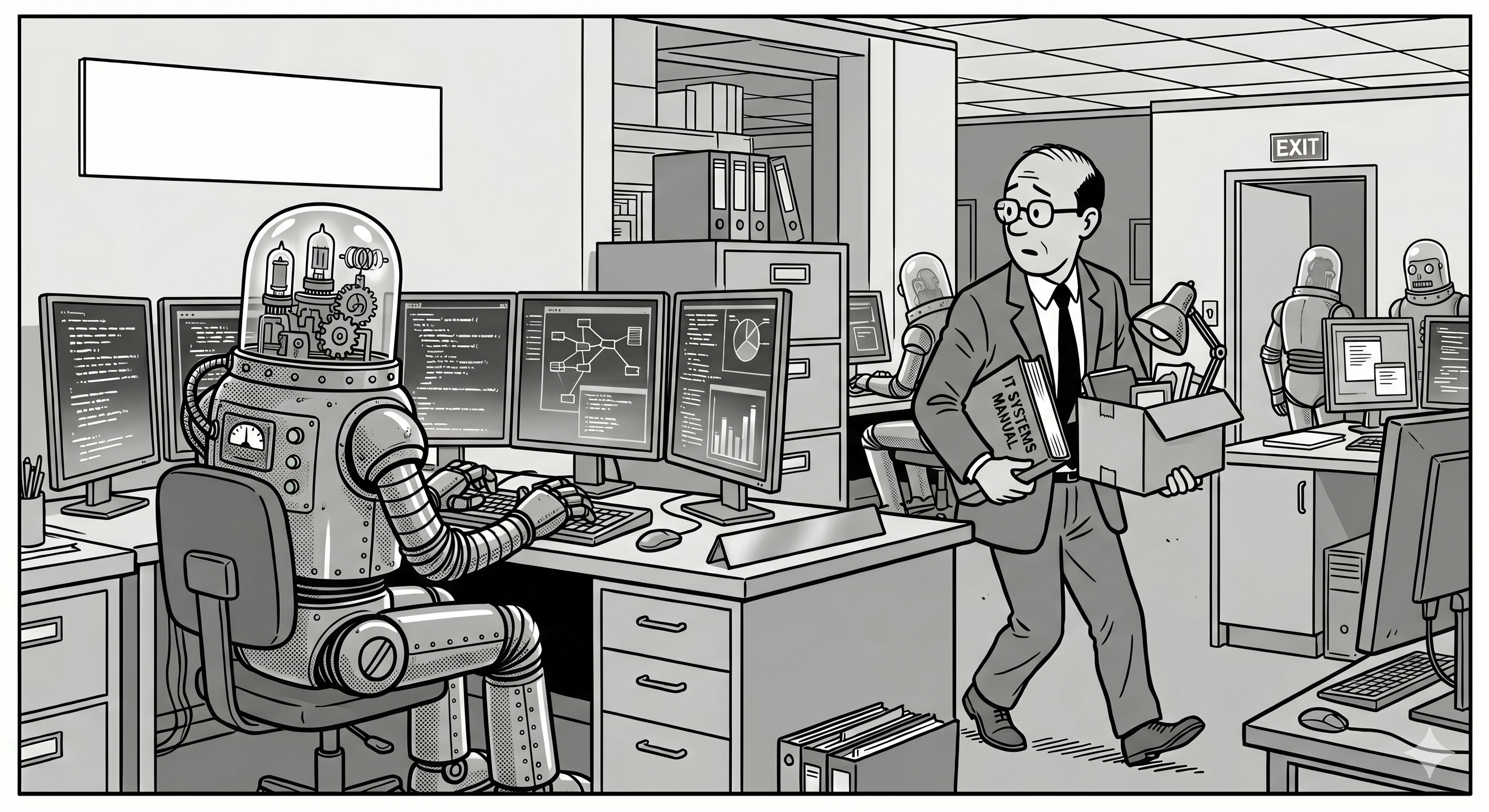
The question sounds rhetorical. It is not.
In March 2026, Anthropic published a labor market impacts report based on real enterprise usage of its Claude model. The headline finding: computer programmers have 75% of their work tasks already covered by observed AI usage. That is the highest exposure of any profession measured. Customer service representatives and financial analysts sit nearby in the top ten.
IT consultants are not in that list separately. But they are adjacent enough to software development, systems analysis, and technical advisory that the question deserves a direct answer.
So: will AI replace IT consultants?
The honest answer is that it depends entirely on what kind of consultant is being described. Some of what consultants do today will be automated. Some of it will be worth more, not less, as AI spreads through the businesses they advise. The two groups are not the same people doing the same work.
I. What the research actually measures
Anthropic's March 2026 report, authored by economists Maxim Massenkoff and Peter McCrory, introduces a metric called observed exposure. Instead of asking what AI could theoretically do, it measures what share of an occupation's tasks AI is already performing in real, paid usage today.
The distinction matters. Theoretical exposure overstates the disruption. Observed exposure shows the disruption that has already happened.
For computer programmers, observed exposure is 75%. For customer service representatives, 70%. For data entry clerks, 67%. The pattern is consistent: roles where the work is well-structured, repeatable, and produces text or code outputs are the ones where AI has already absorbed the largest share of the task load.
Consulting work fits unevenly into that pattern. The drafting of reports, the synthesis of research, the production of slide decks, the writing of audit findings, the comparison of vendor offerings: all of this is text production, and all of this is exposed. The diagnostic conversation with a founder, the judgment call about which dependency is structural and which is cosmetic, the political reading of an internal team, the willingness to say something the client does not want to hear: none of this is text production, and none of it is currently absorbed by any model in production.
II. The split inside the profession
The phrase IT consultant covers a wide range of work. At one end, it describes someone who configures networks, troubleshoots hardware, runs SaaS migrations, and produces standard implementation playbooks. At the other end, it describes senior advisors who shape technology strategy, mediate vendor decisions, and act as the trusted external voice during a board-level technology conversation.
The first group is doing work that is increasingly automated. AI tools handle network configuration generation, infrastructure-as-code drafting, deployment script creation, and routine documentation faster and more cheaply than a junior consultant. A small business that once paid 4,000 EUR for a Microsoft 365 migration plan can now produce 80% of that plan with a Claude or ChatGPT subscription and a competent operations manager.
The second group is doing work that AI cannot currently absorb. Reading the room. Identifying the political reason a project is stuck rather than the technical one. Telling a founder that the decision they have already made is the wrong one. Producing the kind of recommendation that survives contact with a defensive internal team because it was built on relationships, not on a prompt.
The question is not whether AI replaces consultants. It is which kind of consultant a given person is, and whether that kind of work is still in demand.
III. What the market data shows
Several independent sources put the global IT consulting market between 84 billion USD and 127 billion USD in 2026, depending on how the segment is defined, with projected growth of 6.5% to 13.4% per year through 2030. Verified Market Research's September 2025 forecast puts the market at 906 billion USD by 2032 at a 7.4% CAGR. The Business Research Company's 2026 report puts the figure at 210 billion USD by 2030 at 13.4% CAGR.
These numbers do not describe a profession in decline. They describe a profession growing alongside the automation that supposedly threatens it.
The growth driver, according to all three reports, is the same: digital transformation programs in mid-sized businesses, cybersecurity, and AI integration itself. Market Reports World's 2026 analysis found that 49% of enterprises reported internal skill shortages in cloud engineering, data science, cybersecurity, or enterprise architecture. That gap is what consultants fill. AI does not close it. AI widens it, by raising the floor of what businesses are expected to be capable of without raising the ceiling of internal skill.
A 2024 Boston Consulting Group study found that organizations with structured AI adoption processes reported 3.5 times higher satisfaction with their AI investments than those that adopted tools without a defined evaluation framework. The framework is what consultants supply. The tools are not the bottleneck. The judgment about which tool, deployed against which problem, integrated into which existing system, is the bottleneck.
IV. Common questions, answered directly
If AI handles 75% of programmer tasks, why would consulting hold up?
Programming and consulting are different work, even when the consultant has a programming background. Programming produces code. Consulting produces decisions. The fraction of a senior consultant's time spent producing code that an AI model could now generate is small. The fraction spent producing decisions, recommendations, and the justifications behind them is most of the engagement. AI is good at the first. It is not yet competitive at the second.
Will junior consultants get squeezed out?
The junior consulting role as it existed five years ago is already being squeezed. The work that defined that role, drafting findings, reformatting research, producing first-pass deliverables, is the work AI does best. Firms that hired juniors to handle that work are reducing those hires. This is not speculation. McKinsey, BCG, and Accenture have all reduced junior intake over the past two years, and the reduction is not a hiring freeze but a structural shift.
What replaces it is unclear. The traditional path was junior to senior through five to seven years of apprenticeship on the kind of work AI now handles. Without that apprenticeship, the pipeline to senior consultant is broken. This is a problem the profession has not yet solved.
What about non-technical IT consultants?
The label IT consultant is sometimes attached to people who advise on technology procurement, vendor selection, and SaaS adoption without writing code or designing systems. This work is closer to procurement consulting than to technical consulting, and it is highly exposed. Comparison reports, vendor evaluations, and adoption playbooks are exactly the kind of structured text production that AI already produces well. Practitioners in this category should expect significant pressure on rates and engagement length over the next three to five years.
Does AI affect the audit side of consulting?
Yes, and unevenly. AI tools can read code, identify common security issues, and surface dependencies that were not pinned. Static analysis of this kind has been improving steadily for two decades and AI accelerates it. What AI does not yet do is the architectural judgment, the read of the team that wrote the code, or the connection between a finding and a business consequence. A founder receiving an automated security report gets a list of issues. A founder receiving a human audit gets the same list, prioritized against the specific risks the business is currently carrying, with a remediation plan that the founder can defend in front of investors.
The two are not interchangeable. A startup running a Lovable-built product through a free static analysis tool is not getting the same product as a startup running it through a structured technical audit. The former produces a checklist. The latter produces a decision.
V. The trajectory that is most consistent with the data
Three things are true at once.
The work that consists primarily of producing structured text outputs (reports, comparison tables, implementation plans, vendor assessments, generic security findings) is being absorbed by AI. The rate of absorption is accelerating, not slowing. Anthropic's observed-exposure metric will likely cross 50% for several adjacent professions by 2027.
The work that consists of producing decisions, judgments, and recommendations grounded in context the AI does not have, is not being absorbed. It is becoming more valuable, because the businesses that need it now have access to AI tools whose output they cannot evaluate without human guidance. A founder who runs a vibe-coded application through Cursor is not in a stronger position than a founder who runs it through a human auditor. They are in a more confused position, with more output to interpret and no framework to interpret it within.
The middle layer, the consultants who built careers on the boundary between the two, is the layer under the most pressure. Their work product is partially absorbable and partially not. Their pricing reflects an apprenticeship-era cost structure that AI is breaking. Their clients are increasingly expecting AI-augmented delivery times at AI-augmented prices, while still expecting the judgment of the senior version of the role.
For practitioners in this middle layer, the pressure is real. For practitioners at the senior end, the demand is rising. For new entrants, the path to senior is harder than it was, and nobody has yet rebuilt it.
VI. What this means for businesses considering external help
The question for a business is not whether AI is replacing IT consultants. The question is whether the consultant being considered is doing the kind of work that AI absorbs, or the kind of work that AI does not yet absorb.
A consultant whose deliverable is a 60-page report produced from a generic methodology is selling something a business can now generate at home. The price gap between the two will close. The remaining justification for hiring that consultant is brand, time savings, or political cover, none of which holds up at consulting rates.
A consultant whose deliverable is a one-page recommendation produced from a specific engagement, defended in front of a leadership team, is selling something AI cannot produce. The price for that work is going up, not down. There are fewer practitioners doing it well, and the businesses that need it have more reason to find them than they did three years ago.
The decision is the same one it has always been, made more sharply by AI rather than made obsolete by it. Identify the specific judgment the business needs. Verify the consultant has produced that judgment in similar contexts before. Pay for the judgment, not the document.
Batista Consulting works with European SMEs and startups that need an honest read on their technical situation. The deliverable is not a 60-page report. It is a decision the business can act on. Get in touch.
Sources
[1] Anthropic, "Labor market impacts of AI: A new measure and early evidence," March 2026.
[2] Built In, "Anthropic's Economic Index Shows the AI Skills Gap Is Growing," April 22, 2026.
[3] Verified Market Research, "IT Consulting Services Market," September 2025.
[4] The Business Research Company, "IT Consulting Global Market Report 2026."
[5] Market Reports World, "IT Consulting Services Market Share & Trends," 2026.
