
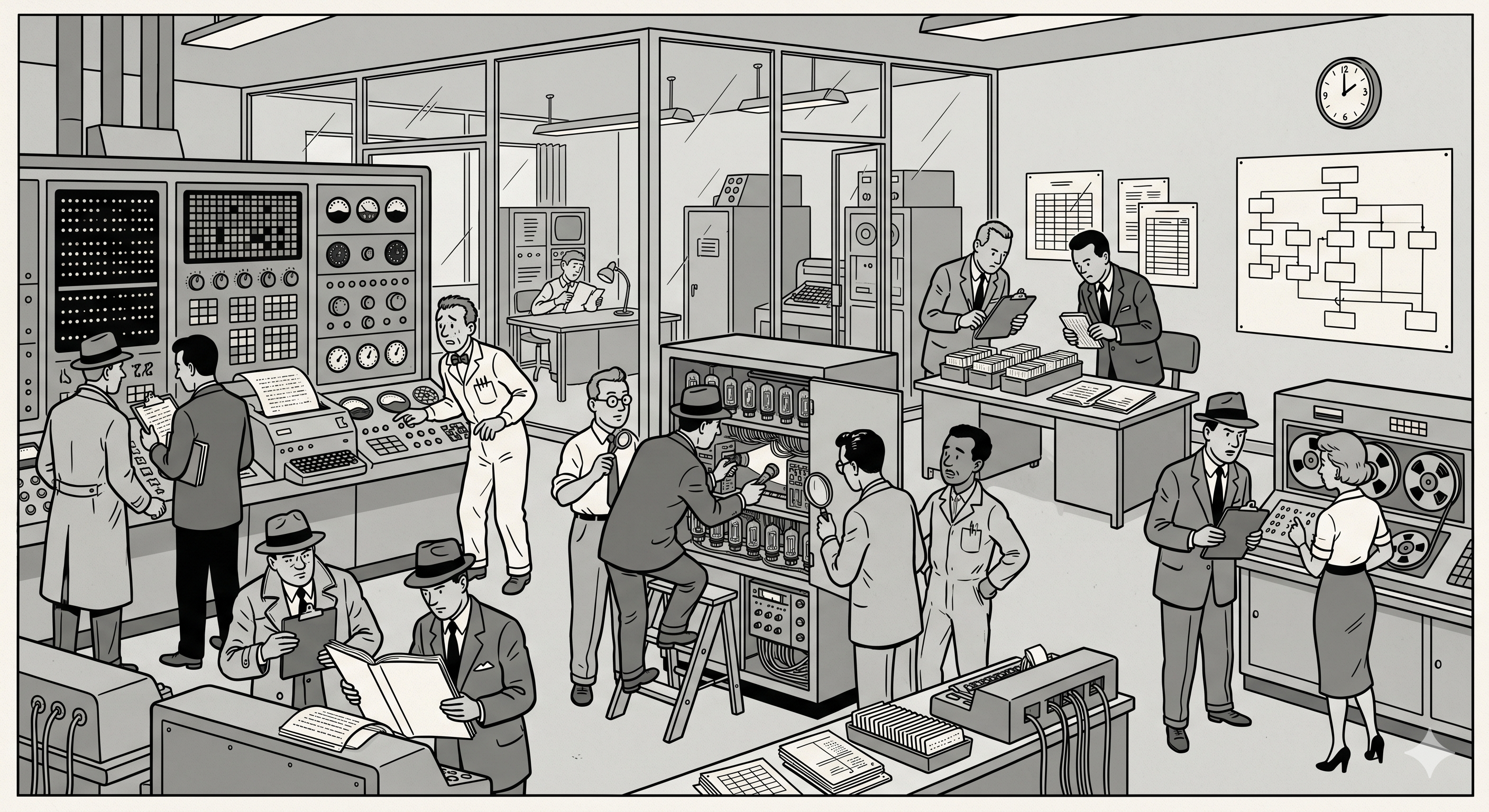
A founder asks what they are buying when they commission a technical audit. The honest answer is a process and a document. The process is two weeks of structured inspection. The document is a ranked list of what the inspection found.
Most people picture an audit as a security scan. A scan is part of it. The larger part is a person reading the system the way the next engineer, or the next investor's diligence team, will read it, and writing down what they see. Here is what happens, stage by stage.
I. What an audit is, in one paragraph
A technical audit is an independent review of how software is built. Not what it does for users. How it is built underneath. It covers the codebase, the architecture, the infrastructure, the security posture, and the development process around all of it. The auditor reads the code, examines the deployment pipeline, checks the dependency tree, reviews the access controls, and documents what they find. The output is a written report, not a verbal reassurance.
II. Stage one, scoping and access
The audit begins before any code is read. The first conversation establishes what the business is worried about and what it depends on. A SaaS product processing payments has a different risk profile than an internal tool that moves data between two systems. The scope is set against the actual risk, not against a generic checklist.
Access comes next. The auditor needs read access to the repository, the infrastructure configuration, the deployment pipeline, and a list of the third-party services the application depends on. This stage usually takes a day. The most common delay is that no single person at the company has a complete list of where everything runs, which is itself a finding.
III. Stage two, reading the code and the architecture
The core of the audit is a person reading the system. Static analysis tools run first and flag the obvious: hardcoded secrets, unpinned dependencies, known-vulnerable packages. These tools are fast, and they catch the patterns AI-generated code reproduces most often. Veracode's October 2025 GenAI Code Security Report found that AI models chose an insecure implementation 45% of the time across languages, and above 70% in Java. CodeRabbit's December 2025 analysis put the vulnerability rate of AI-co-authored code at 1.88 times that of human-written code. The scanner catches a share of this. It does not catch the rest.
What the scanner misses is structural. Whether the authentication logic actually enforces the access controls it appears to enforce. Whether the database design will survive growth. Whether a service boundary contains a failure or spreads it. Broken object level authorization, the flaw where one user can read another user's data by changing an identifier in a request, has sat at the top of the OWASP API Security Top 10 since 2019. It is the most common and most easily exploited API bug, and it is invisible to a scanner that does not understand who is allowed to see what. A person has to trace it.
IV. Stage three, infrastructure, data, and exposure
The review extends past the code to where the code runs. The auditor checks how data is stored, who can reach it, and what is exposed to the public internet. This is where the most damaging findings tend to live. In May 2026, Axios verified that a series of AI-built applications had defaulted to public access and been indexed by ordinary search engines, exposing a shipping company's vessel schedule, a health company's active clinical trials, and a Brazilian bank's internal financial data. No attack was required. A search bar was enough. An audit checks for this class of exposure before someone else finds it.
V. Stage four, findings, severity, and the report
Every issue found is written down, classified by severity, and ordered for action. Severity is not the auditor's opinion. It is a function of how likely the issue is to be exploited and how much damage it does if it is. A hardcoded key in a public repository is critical. A missing database index that will slow a query at scale is worth fixing, but it is not an emergency.
The report is the deliverable. It names each issue, explains the business consequence in plain terms, and recommends a sequence for remediation. It is written so a non-technical founder can read the summary and a future engineer can act on the detail. The same document answers the questions an investor's technical due diligence will ask, which is why founders raising in the next year commission an audit before the diligence team runs its own.
VI. What it costs and how long it takes
A technical audit of an early-stage application runs between 5,000 and 30,000 EUR, depending on the size of the codebase and the depth of the review. The fieldwork is usually two weeks. The figure to compare it against is the cost of the incidents it prevents. IBM's 2025 Cost of a Data Breach report puts the average breach at 4.88 million USD. For a company carrying customer or payment data on an unreviewed codebase, the audit is the cheaper number by a wide margin.
VII. What an audit does not do
An audit captures the state of a system at one point in time. It is not a guarantee, and it is not a substitute for ongoing engineering practice. It will not predict every future failure, and it does not write the fixes. It tells the business what is there, ranked by what matters, so the next decision is made with information instead of hope.
For a product built quickly, by AI tools or by a single developer who has since moved on, that information is usually the difference between a known problem and a surprise. The audit turns the second into the first.
Batista Consulting runs technical audits for European startups and SMEs. The deliverable is a ranked report you can act on, not a verbal reassurance. Get in touch.
Sources
[1] Veracode, "GenAI Code Security Report," October 2025.
[2] CodeRabbit, "AI-Generated Code Security Analysis," December 2025.
[3] OWASP, "API Security Top 10" (broken object level authorization ranked first since 2019), via SoftwareSeni.
[4] Axios, "Vibe-coded apps were exposed by default," May 7, 2026.
[5] IBM, "Cost of a Data Breach Report," 2025.
